


It was quite a long time ago when the techie folk at jaam started talking to me about agentic AI, and they were very excited about it. Infectiously so.
Since then, I started thinking seriously about AI agents and I’ll admit that initially my mind went straight to the big stuff. Complex business processes, enormous volumes of information, clever integrations and agents working away behind the scenes doing things that I only partially understand, but which make the technical team at jaam very happy.
And, of course, agents absolutely can do all of that. We’re already seeing just how powerful they can be when they’re applied to complex processes and given the right combination of instructions, information and tools.
But the more I heard about what was possible, the more I started thinking about it from a much more personal perspective. Rather than asking what an AI agent could do for a large organisation or a complicated business process, I started wondering what one could actually do for me. I’m a marketer, not a technologist, so what are the things in my own working life that an agent could take on, and what difference would that make?
As it happens, I had just the job for one.
The agent does the hours of searching, reading, filtering, comparing and summarising, while a human retains control over what jaam ultimately puts its name to.
Keeping up with Microsoft AI is practically a job in itself
Part of my role at jaam is keeping abreast of what’s happening in the Microsoft AI world, which, as anyone who has attempted to do the same recently will know, is no small undertaking.
There is an extraordinary amount happening across Copilot, agents, Azure AI, Fabric and the wider Microsoft ecosystem, with new announcements, features, roadmap changes, technical updates, opinion pieces and use cases appearing constantly. I genuinely want to know about them, partly because it’s my job, but also because I find this whole area fascinating. I also suspected that plenty of our customers, contacts and wider network would quite like to know what was happening too.
What I didn’t particularly want to do was spend hours every week trawling through dozens of different sources, reading everything, working out what was genuinely significant and then pulling the useful bits together.
Which led to a conversation with our development team along the lines of: could we get an agent to do this for me? As it turns out, we could.
Introducing the jaam NewsAgent
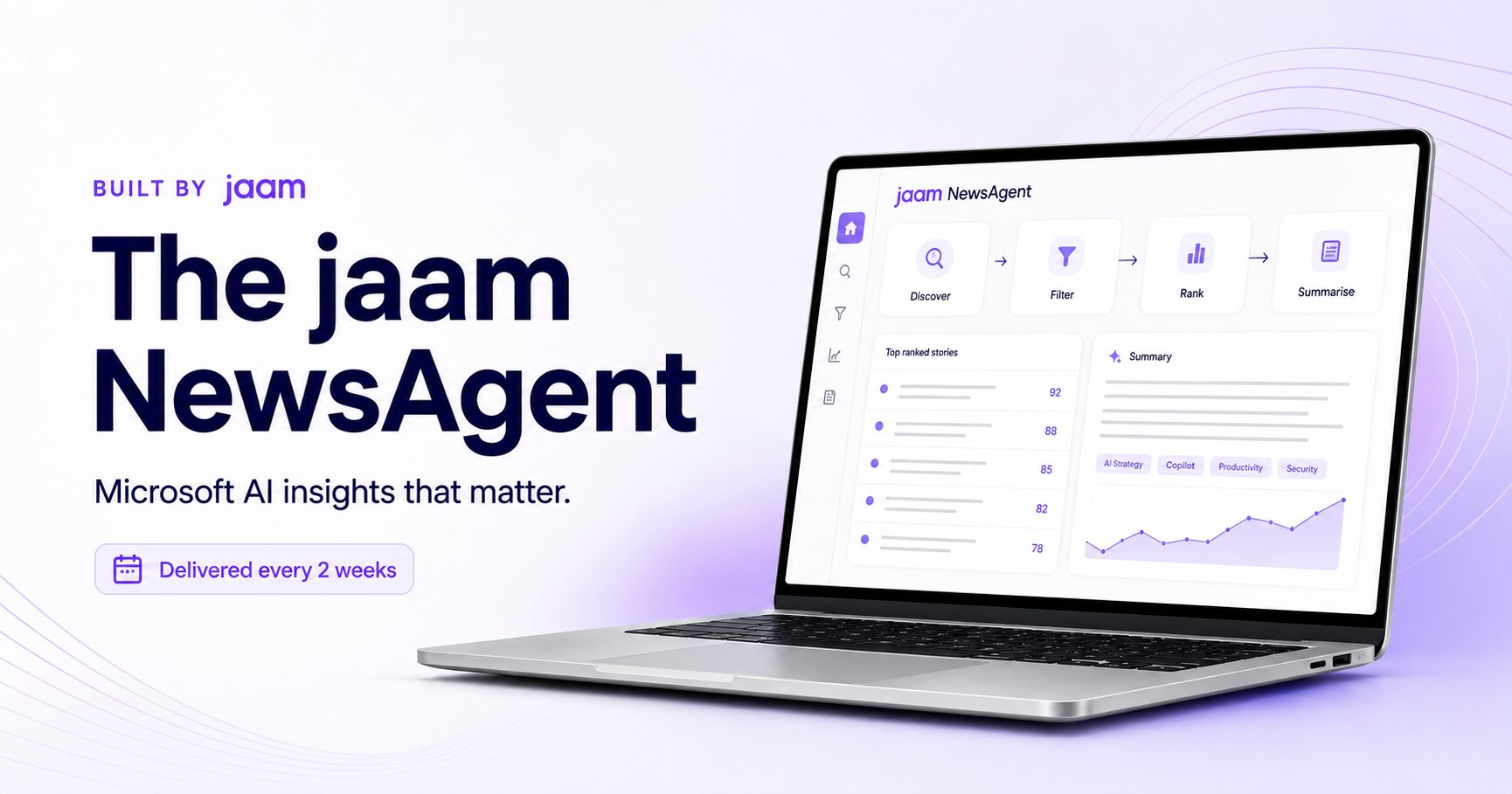
The brief I gave the team was actually fairly straightforward. I wanted something that could go scurrying off into the online Microsoft world, find the latest AI news and developments from the sources we care about, read and assess what it found, and then work out which stories were most relevant to the kind of people we work with.
Crucially, I didn’t just want a news scraper that would find anything containing the words “Microsoft” and “AI” and dump it into a list. The really time-consuming part of the job isn’t finding information; it’s deciding what is worth somebody else’s attention.
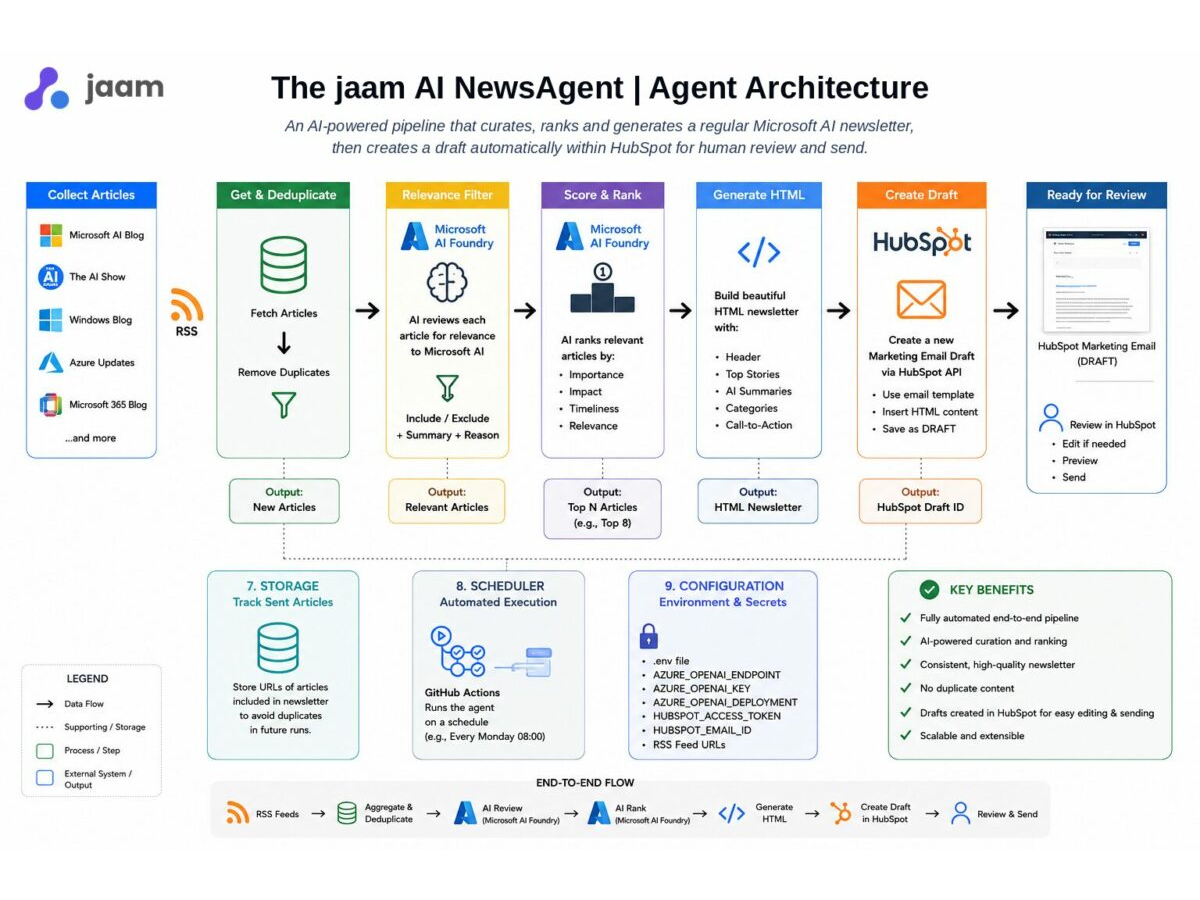
It was a delight to be told “that’s a good idea” by the tech team, and then off they went to work! If you’d like a little more info on the technicalities, I’ve used the architecture diagram as this blog image 😊.
The jaam NewsAgent has a brief about who our audience is and the things they are likely to care about. It uses that context to assess and prioritise the stories it finds, pulls out the important points and prepares its recommendations and summary stories. Those then go into HubSpot, where they are collated into an HTML email and sent to a human for review and approval before anything is sent.
I love this division of labour. The agent does the hours of searching, reading, filtering, comparing and summarising, while a human retains control over what jaam ultimately puts its name to. It isn’t about taking a person out of the process; it’s about using a person for the bit where their judgement and accountability really matter, rather than asking them to spend half a day trawling the internet first.
It made me look at agents a wee bit differently
Creating the jaam NewsAgent has made something click for me about the potential of this technology.
There is, understandably, a lot of conversation around the big, transformational applications of agentic AI. At jaam, we spend a lot of time looking at exactly those kinds of opportunities: processes that cross teams and systems, involve lots of decisions and hand-offs and could work very differently if agents were introduced into them.
But I think there is another, much more accessible way to start thinking about agents, which is simply to look at your own working life and ask what consumes a disproportionate amount of your time and attention.
It might be keeping track of developments in your industry or changes in regulation. Perhaps it’s preparing for meetings by researching companies and people, or pulling together information from several different places to produce a weekly report. It could be reviewing incoming requests and deciding who needs to deal with them, checking documents against a set of criteria, monitoring projects for things that have slipped, identifying unusual changes in data, or working through customer feedback to spot patterns that deserve attention.
Some of those jobs are relatively simple and others could form part of a much more complex process, but they all have something in common: they involve work that is useful and often important, yet takes up a considerable amount of human time.
Once you start looking at your working week through that lens, it becomes surprisingly easy to spot potential jobs for an agent.
The bit I find most interesting is the decision-making
This is also where the jaam NewsAgent helped me understand more about the difference between simply automating something and giving work to an agent.
We haven’t told it that if X happens, it must always do Y. Instead, we’ve given it a brief. It knows what we’re interested in, who we are producing the news for, what sorts of developments are likely to matter to those people and what we want it to produce at the end.
Within that framework, it has decisions to make. Is this story relevant enough? Is another story more important? Are two different sources essentially talking about the same announcement? What is the useful point buried in a much longer technical update and why might somebody running a business, technology team or transformation programme actually care about it?
For somebody like me, who approaches all of this from a marketing and business perspective rather than a technical one, that is where things get really interesting. I don’t particularly need to understand how to build an AI agent myself. What I need to be able to do is explain the job I want done, the context around it, what a good outcome looks like and where I want a human to remain involved. That feels like a much more approachable starting point for thinking about the art of the possible.
And if my agent learns through human-in-the-loop review, well, that’s even better.
What’s the job you’d happily hand over?
There are plenty of big questions being asked about how AI will transform organisations and industries and those conversations absolutely need to happen. But I also think there’s value in starting somewhere much more ordinary.
Think about your own working week and the jobs you repeatedly have to find time for. What do you spend hours reading, checking, comparing, collating or summarising? What information are you constantly trying to keep on top of? What has to be reviewed before the next stage of a process can happen? What useful piece of work regularly gets pushed down the list because nobody quite has the time to do it properly?
Most importantly, what do you find yourself doing for the fiftieth time while thinking, surely there must be a better way of doing this?
For me, one answer was keeping on top of Microsoft AI news, so we built an agent to help. It solves a genuine problem for me, it saves a significant amount of time and, as an added bonus, it creates something that we think will be genuinely useful to other people too.
It also means we’re drinking our own juice at jaam. We talk to organisations about the potential for agents to take on work, make decisions within a defined brief and help people use their time more effectively, so it seems only right that we should be doing exactly the same ourselves. The jaam NewsAgent is one relatively simple example, but it has left me with a question that I think is worth asking:
If you had an AI agent working alongside you tomorrow, what would you ask it to do?
If keeping up with Microsoft AI is one of the jobs you’d happily hand over, you can sign up for the jaam NewsAgent and let ours do the reading for you.
And if this has made you look at your own to-do list slightly differently, come and talk to us at jaam. Tell us about the job that takes too long, the process that involves too much manual effort, or the useful thing you never quite have enough time to do.
There’s a very good chance we’ll start by asking: could an agent do that?