


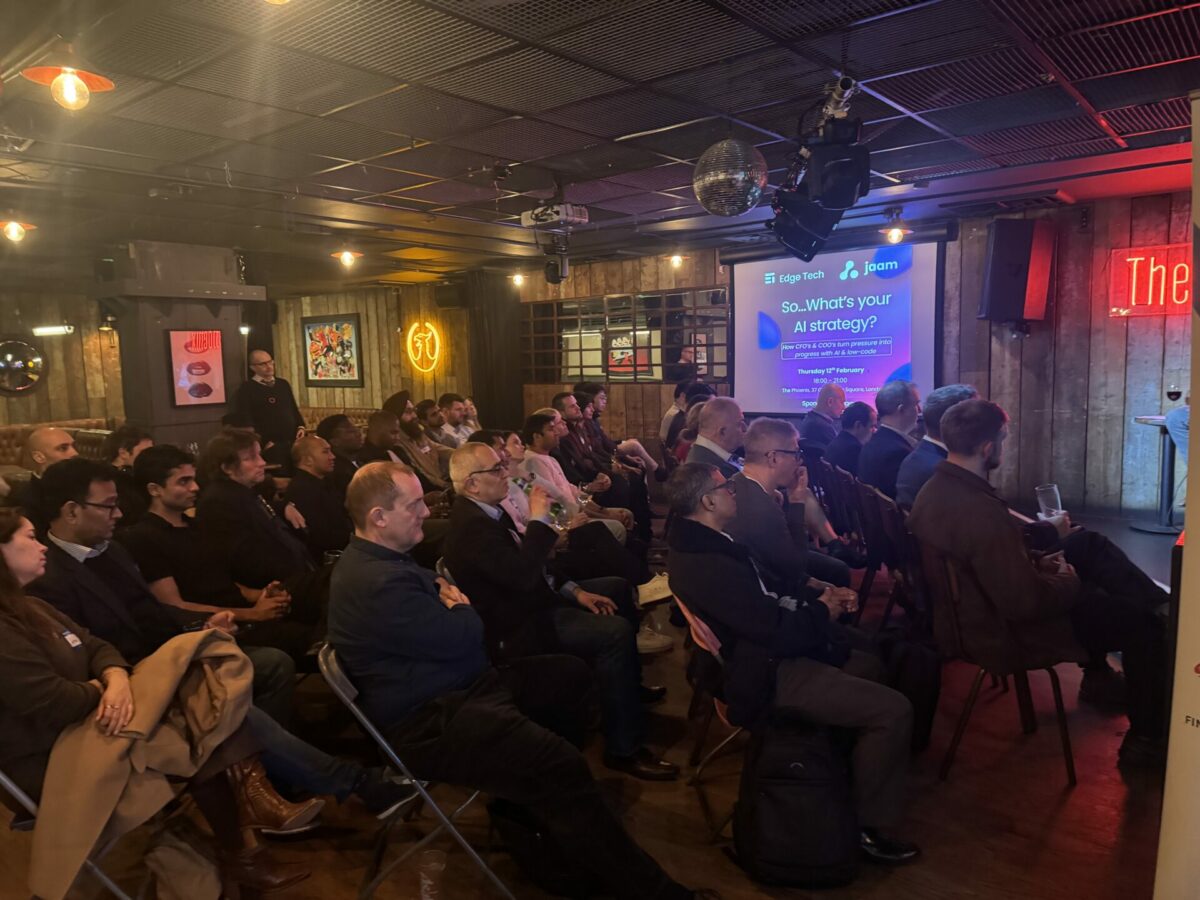
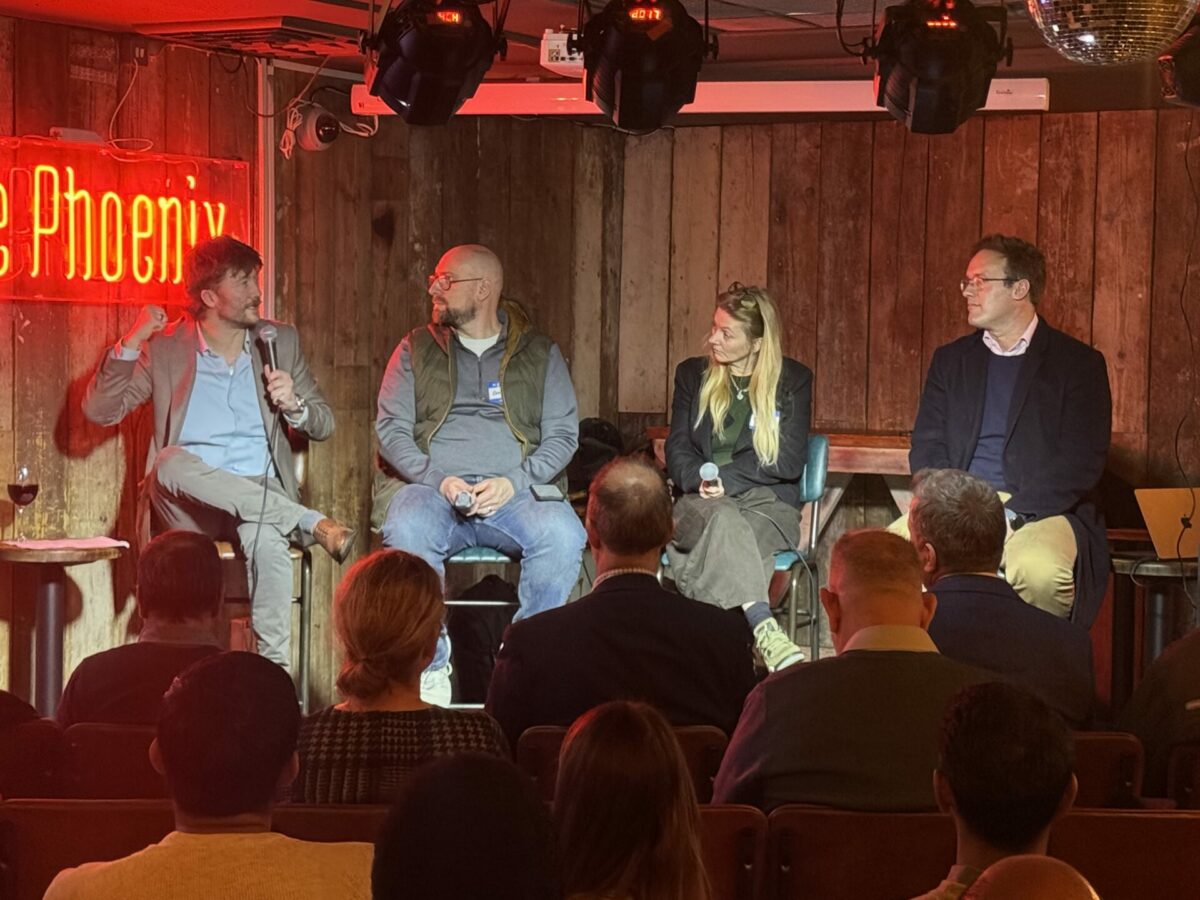
Last week, jaam automation partnered with Edge Tech to run a senior leadership roundtable focused on one deceptively simple prompt:
“We need an AI strategy.”
It was one of the most engaged, candid conversations we’ve seen, and this despite the London transport hiccups that meant the room was still filling as the discussion began. What followed was a practical, grounded conversation about what it really takes to move AI from boardroom ambition to operational impact.
For those who couldn’t join us, here’s what stood out:
Don’t start with tools. Start with business problems.
When a CEO – or a board – declares the need for an AI strategy, the instinct is often to explore platforms, vendors and the latest capabilities.
The consensus in the room last week was that that’s the wrong starting point. AI strategy should begin with clarity around business priorities:
- Are we focused on revenue growth?
- Cost reduction?
- Risk mitigation?
- Customer experience transformation?
Before discussing models or platforms, leadership teams must align on what success actually looks like. Without that alignment, AI becomes fragmented experimentation rather than coordinated transformation.
We think this was the most resonant point of the evening:
AI is not a technology strategy. It’s a business strategy enabled by technology.
Why AI projects stall in large organisations
Many attendees shared similar frustrations: strong ambition, promising pilots, but limited scale.
The barriers were strikingly consistent:
- No clear business owner. AI becomes “IT’s experiment” rather than a business priority.
- Poor data quality. Garbage in, chaos out.
- No structured change management. People don’t adopt what they don’t trust.
- Trying to boil the ocean. Overly ambitious programmes that fail to ship tangible wins.
There was strong agreement that credibility is built through delivery, not declarations. Small, high-impact wins create momentum, which in turn earns executive confidence – and confidence unlocks scale.
Who owns AI? The CFO, COO, CTO, or all three?
One of the most engaging debates of the night centred on ownership. The conclusion wasn’t that AI “belongs” to one function, but that sustainable success depends on shared accountability:
- The CTO owns capability and architecture
- The COO owns operational impact
- The CFO owns value realisation and risk
- The executive team must remain aligned
The phrase that resonated most strongly:
Business-led. Tech-enabled. Finance-governed.
When AI sits in a silo, it stalls, but when leadership co-owns it, it scales.
Quick wins vs long-term strategy
There’s an inherent tension between delivering fast results and building durable foundations and the room landed on a pragmatic middle ground:
- Deliver quick wins to build credibility
- Avoid isolated experiments that can’t scale
- Treat pilots as stepping stones, not endpoints
Pilots when considered together form the basis of a longer-term strategy.
Communicating AI without the jargon
A recurring theme was how difficult it can be to communicate AI strategy across non-technical stakeholders. The advice shared was refreshingly simple:
- Lead with outcomes, not models
- Avoid acronyms unless asked
- Use concrete examples tied to each function’s reality
When boards ask about AI, they are rarely asking about neural architectures. They’re asking about risk, return and competitive advantage. Which leads to another honest moment from the discussion…
What keeps leaders awake at night?
During the event, two worries around AI adoption were identified:
- Overpromising and underdelivering
- Regulatory and governance exposure
As AI adoption accelerates, so does scrutiny. Governance cannot be an afterthought bolted onto innovation, it must be embedded from the outset, particularly where financial, operational or customer risk is involved.
Collaboration is your best friend
Perhaps the clearest takeaway of the evening was that AI maturity isn’t just about capability, it’s about coordination.
Effective organisations:
- Operate from a shared roadmap
- Hold regular cross-functional steering sessions
- Track clear KPIs tied to business value
- Embed governance into delivery cycles
In a silo, AI initiatives can easily fail. When companies work in alignment and co-ordination, success is easier to come by.
A partnership event that packed a punch
The partnership between jaam automation and Edge Tech operates from a common philosophy; AI transformation should be grounded in operational reality, embrace humans-in-the-loop and offer measurable value.
The conversation at our event reinforced that organisations don’t need more experimentation, but do require structure, alignment and delivery discipline. That’s exactly where the Edge Tech/jaam partnership is focused, helping leadership teams move from ambition to execution with clarity, governance and commercial impact.
It was a genuinely energising evening, and one of the most engaged rooms we’ve shared, with some of the most positive feedback we’ve received. To everyone who joined us (even those delayed by the tubes), thank you for the candour and the challenge.
And to those who couldn’t attend – we hope this blog has delivered some insight. Perhaps we’ll see you at the next event!
If you’d like to explore how to turn AI ambition into measurable outcomes within your organisation, we’d be delighted to connect.